

Peter Higgs, founder of Beegone – bee removal and live homing experts explores honeybees and their potential impact on historic buildings. This piece originally appeared in the SPAB members' Magazine in Summer 2026. Become a member to get the next issue.
Across the UK, we continue to see increasing numbers of honeybee colonies establishing themselves in historic and listed buildings: behind lath and plaster, within chimneys, under stone copings, inside oak beams, and within roof voids that have stood undisturbed for centuries. While the instinctive reaction can often be one of concern or urgency, the reality is that these situations demand calm, informed decision-making grounded in conservation principles.
Honeybees are among the most fascinating living systems most people will ever encounter. A single colony functions as a superorganism: tens of thousands of individuals operating with collective intelligence, complex communication, and astonishing efficiency. For centuries, honeybees have coexisted quietly with traditional buildings, often unnoticed and undisturbed. Today, however, that coexistence is becoming more visible and more problematic.
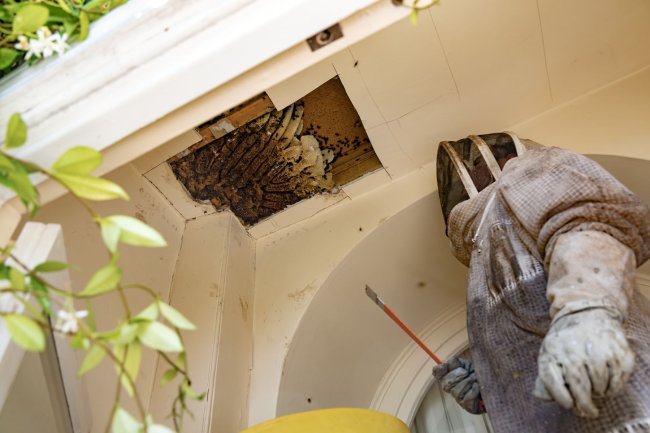
Whether already encountered or not, the presence of honeybees within historic buildings presents a distinct challenge: how to protect often irreplaceable fabric while responding responsibly to a living colony. The question is rarely purely technical, as it is one that carries ethical, legal, and ecological weight.
Why bees choose old buildings
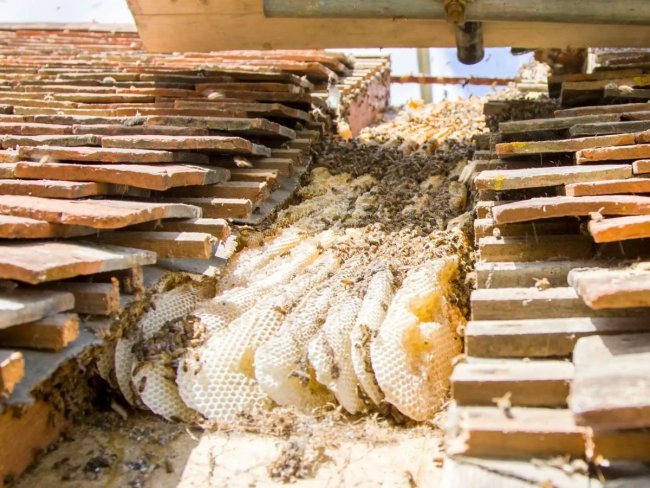
To a honeybee swarm searching for a permanent home, historic buildings are close to perfect. Traditional construction offers:
- thick walls with thermal mass
- breathable materials that regulate moisture
- quiet voids rarely disturbed
- chimneys, roof spaces, timber frames, and masonry cavities formed over centuries
Modern buildings, by contrast, are often sealed, frequently disturbed, and comparatively inhospitable. As a result, bees are increasingly drawn to churches, barns, and old and listed dwellings particularly those with disused chimneys or traditional roof structures. Once established, a colony may remain in place for many years. During that time, it will produce large quantities of honey and wax -up to 50Kg a season- generate heat and moisture and adapt its internal structure to the surrounding fabric. None of this is malicious but all of it has consequences if left unmanaged.
Should we simply leave bees alone?
This is a frequently asked question. Leaving honeybees undisturbed can sometimes be appropriate in the short term, for they are not pests that require automatic intervention; however, their presence within buildings can carry consequences for the structure, its occupants, and occasionally the bees themselves.
Honeybees naturally swarm, often more than once a year. When a colony swarms, a significant proportion of bees leave to establish a new nest, frequently selecting nearby voids or even other parts of the same building. Over time, what began as a single colony can become several, increasing complexity, disruption, and eventual cost if intervention becomes unavoidable.
Honeybees can also affect the timing of essential repairs. Noise or vibration from scaffolding or building works may trigger defensive behaviour, as vibrations are interpreted by the colony as a potential threat. It is often during urgent roof or fabric repairs that bees are first discovered, at which point work may have to stop. Contractors operating on day rates may be unable to continue, leading to delays and additional expense.
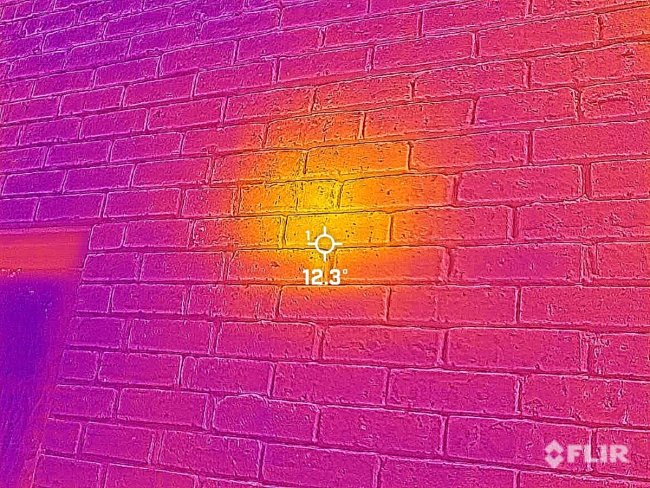
Contrary to popular belief, bees are not dormant in winter. They remain active within the building fabric, clustering to generate heat and surviving on stored honey. If disturbed, they can emerge suddenly, even in cold weather, creating unexpected risks for occupants or contractors.
Damage to buildings is most associated with unmanaged colonies. Honey can melt or migrate particularly following colony collapse or inappropriate treatment leading to staining, blocked ventilation paths, and moisture retention within voids. In historic buildings, trapped moisture can exacerbate decay and, during freeze–thaw cycles, contribute to cracking in lime mortar and masonry.
For some, the idea of ‘wild’ bees living independently is appealing but unmanaged colonies can carry serious diseases such as American foulbrood. This is spread by robber bees accessing unprotected honey and can affect both wild and managed colonies. In managed apiaries, the presence of this disease requires the destruction of affected hives. As with many ecological systems, lack of management can increase risk rather than reduce it. For these reasons, the decision to leave bees in situ should always be informed, monitored, and proportionate rather than assumed to be the safest or simplest option.
The danger of spraying bees
Spraying honeybees rarely resolves the underlying issue and often leaves honeycomb within the building fabric. Honey is hygroscopic and highly attractive to other bees, which will readily rob exposed stores. Any contamination present can then be carried back to surrounding colonies, extending the impact beyond the original site. In historic buildings, spraying introduces uncertainty and wider ecological risk rather than a lasting solution.
Where We Take the Bees
Once carefully removed, we take the honeybees to the charity Beekeeping 4 Hope, which provides safe, new homes for the bee colonies, and is dedicated to using beekeeping as a tool for poverty alleviation and environmental sustainability.
Safety and changing legislation
There is often a mismatch between public expectation and practical reality.
Recent changes mean that many beekeepers are no longer permitted to work at height, use ladders beyond specific limits, or access roof structures without formal safety measures. What might once have been approached informally now rightly requires surveys, scaffolding, risk assessments, and professional oversight. In other words, what may appear to be just bees in a wall is often a multi-disciplinary conservation project.
A conservation-led framework
Where intervention is required, best practice mirrors the principles long championed by the SPAB:
Understanding before action
Every historic building is unique. Construction methods, alterations, materials, and significance must be properly understood before any intervention is proposed.
Minimal intervention
Opening-up should be limited, targeted, and reversible wherever possible, avoiding unnecessary disturbance to historic fabric.
Live removal
Destruction leaves organic material behind and increases the likelihood of recurrence. Live removal avoids these secondary risks and respects the bees’ ecological value. Colonies can then be relocated to new hives at a sufficient distance to prevent return.
Compatible materials
Any reinstatement must remain breathable and sympathetic to traditional construction, using materials appropriate to the building’s fabric.
Prevention matters
Without discreet, appropriate proofing, recurrence is likely sometimes within a single season. Swarms will often attempt to re-enter familiar voids if access points remain.
The true scope and cost of doing it properly
- A properly managed intervention may include:
- initial surveys and investigation using thermal imaging, drones and
- borescopes and often asbestos surveys
- access design
- scaffolding
- live removal of bees
- full removal of honeycomb
- cleaning and drying of voids
- conservation-appropriate reinstatement
- preventative measures to avoid recurrence
Costs can range from several thousand pounds for simpler situations to tens of thousands where access is complex or the building particularly sensitive. What matters is not price alone, but value: avoiding repeat intervention, fabric damage, or irreversible mistakes. Where scaffolding is required, this is often coordinated with other necessary roof repairs, reducing future disruption.
Working across ecology, building fabric, and heritage repair
Many of the challenges discussed in this article sit at the intersection of ecology and historic construction. In practice, such issues rarely occur in isolation. Honeybees may be discovered during roof repairs; bat activity may halt essential works; badger setts may undermine structures; or pest activity may be uncovered within historic timbers during routine maintenance.
The ideal is to manage projects holistically: from initial surveys and access design, through to ecological compliance, repair using compatible materials, and reinstatement appropriate to historic fabric. This approach is particularly relevant where scaffolding, ecological licensing, and building works must be carefully coordinated to avoid repeated disturbance or unnecessary intervention. For owners, custodians, and professionals responsible for historic buildings, this integrated capability can help reduce risk, minimise disruption, and ensure that necessary work is undertaken once and undertaken properly.
More information about Peter Higgs: beegone.co.uk