

Julie Halls, SPAB’s Archive Officer considers a heated but ultimately successful early SPAB campaign led by William Morris.
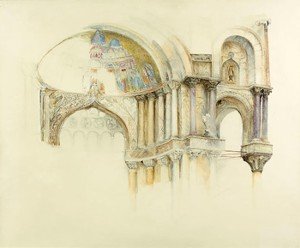
On 6 November 1879, a committee meeting was held at the SPAB office, 8 Buckingham Street, London. The minutes show that it was well attended and had been called ‘especially to consider the threatened removal of the West front of St Mark’s Ch[urch] at Venice’. Among those present were the MP Percy Wyndham, William Morris, William Holman Hunt, William De Morgan, Philip Webb and Edward Burne-Jones. A letter was read from ‘our correspondent at Venice’, and Morris read a draft of a memorial (petition) that he proposed to present to the Italian government.
Morris had received details of major restoration work planned for the west front of St Mark’s, under the supervision of the architect Giovanni Battista Meduna. Meduna had undertaken essential work to the foundations, preventing dangerous subsidence. However, when working on the north and south facades he had overseen the reconstruction of large sections, and demolished other areas completely. He replaced Greek marble cladding, recut or moved stonework and columns, and supplanted medieval mosaics, to the dismay of Morris and others. Now the west front was threatened with a similar fate. John Ruskin wrote: ‘It is impossible for anyone to know the horror and contempt with which I regard the modern restoration’ (John Unrau, Ruskin and St Mark’s, 1984).
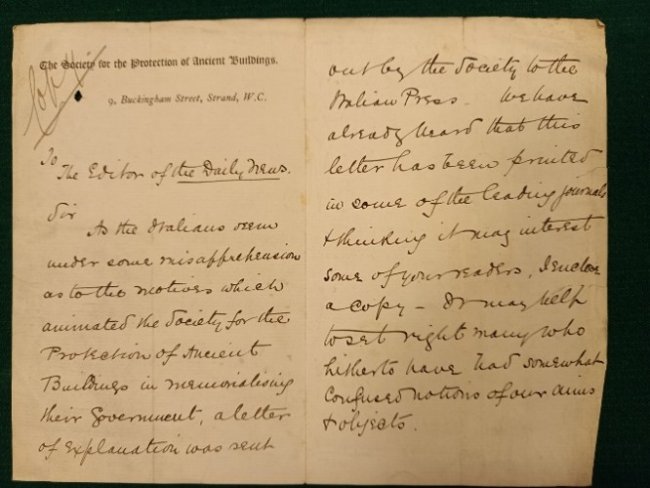
Before the meeting, Morris had already written an impassioned letter to The Daily News, which attracted huge publicity. In it, he states: ‘the restoration of the west front of St Mark’s at Venice, which has long been vaguely threatened, is to be taken in hand at once. A Commission is called for next month to examine its state and to determine whether it is to be pulled down immediately or to be allowed to stand till next year.’ He goes on: ‘Those only can think the “restoration” of St Mark’s possible who neither know nor care that it has now become a work of art, a monument of history, and a piece of nature’.
A public campaign
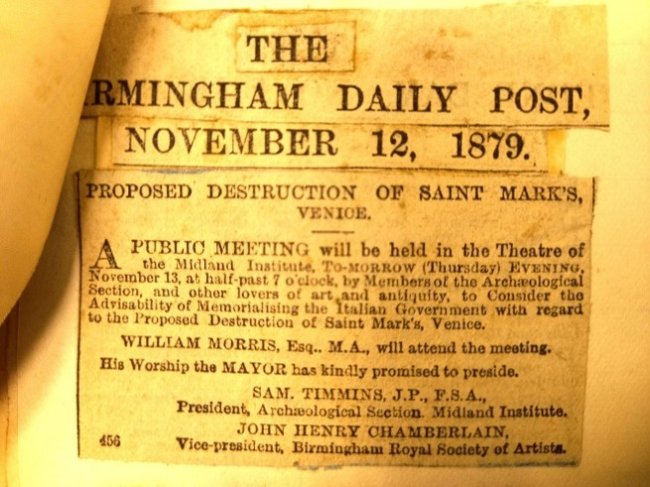
Events moved quickly. Public meetings were held across the country, with Morris speaking in Birmingham and Oxford, and articles appearing in all the major newspapers. By the time of a second special meeting of the Committee on 26 November, Morris’s memorial had attracted 1,500 signatures – this was to rise to around 2,000. The memorial was remarkable in that it was signed by the most influential and celebrated figures of the day. These included Gladstone, Disraeli, Charles Darwin, Octavia Hill; Thomas Carlyle, George Eliot, Robert Browning, Tennyson, academics from major institutions and senior clergymen, as well as those in Morris’s immediate circle.
Unsurprisingly, the Italian press and authorities were incensed. The frequent use in the British press of the term ‘vandalism’ caused particular offence. Although in Britain much of the press was supportive, there was also criticism. Two cartoons in the satirical magazine Punch lampooned the campaign.
On 13 February 1880, a letter from Meduna appeared in the Building News. He denied planning to rebuild the west front, undermining the campaign. The artist Henry Wallis, a Committee member, wrote with concern: ‘These statements if believed by the British Public will prevent us getting support on another occasion’.
Work is halted
Morris wrote an explanatory letter and sent it to the Italian newspapers, and to the Daily News, in an attempt at damage limitation. However, he now faced another problem. A letter from Signor Rezzasco, the Secretary General of the Italian Ministry of Public Instruction, as well as raging against Morris’s original letter in the Daily News, stated that work on St Mark’s had already been halted. It informed the Committee that the Ministry: ‘ordered last May that the Commission of Monuments should study the most rational method of restoring not of rebuilding the façade, as had been done in former times, & in the meantime ordered that no works should be undertaken’. He suggested that ‘as the Society had already obtained what it desired, the memorial should not be sent’.
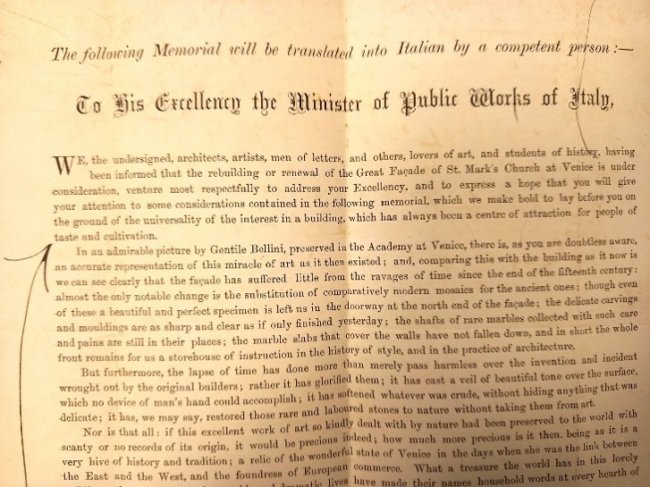
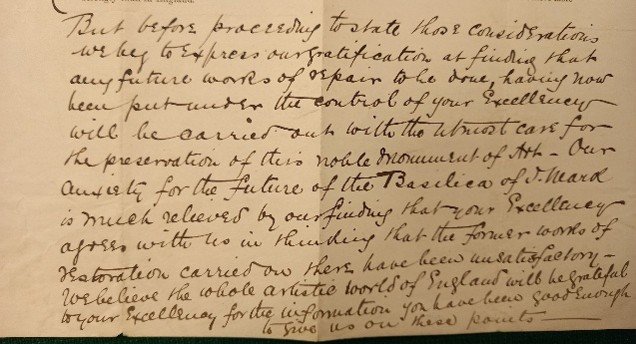
The Committee, however, resolved to go ahead. An amended version in the SPAB archive shows the addition of a paragraph reflecting the new information. It was unfortunate that the memorial was wrongly addressed to the Minister of Public Works, rather than the Minister of Public Instruction, perhaps reflecting the hasty nature of the campaign. A letter in our archive dated 15 December 1879 confirms the receipt and forwarding of the memorial by the British Embassy in Rome.
The outcome
The Committee continued to be concerned about the fate of St Mark’s. Early in 1880 the architect G. E. Street went to Venice on behalf of the SPAB to assess the west front. He wrote a detailed report, concluding that work already completed on the base showed that a complete rebuilding of the west front had indeed been intended. He backed up his arguments with measurements and analysis, writing: ‘I came away in despair about St Mark’s’. Both he and fellow architect, J. J. Stevenson, who also made a report, agreed that the walls were stable and there was no justification for rebuilding.
The plans for the west front of St Mark’s were cancelled, although the reasons for this were a matter of debate. In 1877, Ruskin and Count Alvise Zorzi, a Venetian artist and campaigner, had published a protest which might have caused the Italian authorities to rethink (Robert Hewison, Ruskin on Venice, 2009). Or they may have reached the decision independently. Frank C Sharp suggests the Committee deserves credit for a successful campaign (From William Morris, ed. Chris Miele, 2005).
Although the St Mark’s campaign was dogged by missteps and unfortunate timing, the furore, and the memorial, raised the profile of the SPAB and its work in a way that no quieter protest could have done. It also helped stimulate debate in Italy, marking the start of a more considered approach to building conservation.
The SPAB learned from its mistakes, and adopted a far more sensitive, diplomatic approach in future campaigns outside Britain, helping to ensure that its work to preserve buildings overseas became a key part of its activities.
This article was first published in SPAB members-only magazine. Become a SPAB member to see the latest SPAB Magazine and get access to digital back issues.