
Tessa Wild and archaeologist James Wright explore the graffiti at Kibworth Harcourt Post Mill, Leicestershire. This piece originally appeared in the SPAB members' Magazine in Summer 2026. Become a member to get the next issue.
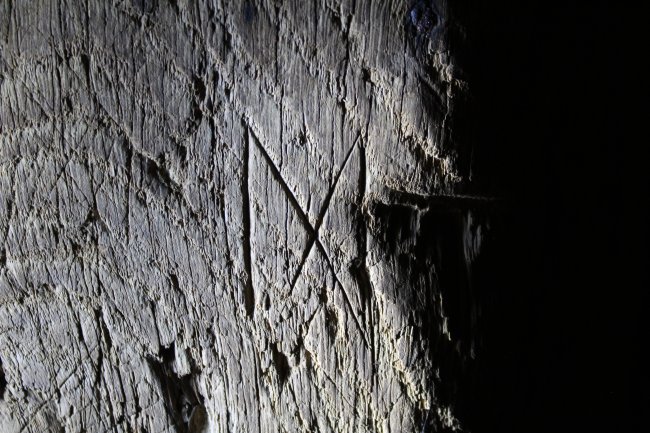
Many people are endlessly curious about what has happened in the past and appreciate that the fabric of historic buildings offers tantalising and intriguing glimpses of an earlier age. For those involved in working with or interpreting the layered history of buildings, the phrase ‘If walls could talk’ often comes to mind and conveys a sense of the hidden history of particular rooms and places that we wish could share their stories. At Kibworth Harcourt Post Mill, the walls literally ‘speak’ from past generations to the present day through the medium of historic graffiti that is incised and drawn on walls and timbers in a variety of different forms. Although much of this graffiti has been visible since we were given the mill by Merton College, Oxford, in 1936, it had not been comprehensively recorded or interpreted and existed as an interesting feature awaiting more detailed exploration. In 2021, we recognised that the graffiti needed to be recorded in advance of the major programme of repair work undertaken and we commissioned a comprehensive survey of the historic graffiti from James Wright of Triskele Heritage. His investigations have revealed many more instances of graffiti than had previously been identified and a much richer understanding of the genesis, meaning and significance of the surviving graffiti.
Although some contemporary graffiti is justly recognised as creative expression and an art form in its own right; many still regard graffiti as an act of vandalism, especially when it is etched on historic buildings. Yet the opposite is true of historic graffiti which is being increasingly recorded and studied because of the valuable insight it affords. As James Wright notes, “Literate graffiti on historic buildings has a great capacity to inform subjects such as genealogy, tourism and travel, prisoners, warfare, and trade. Meanwhile, pictorial graffiti has a tremendous potential to reveal the psychologies and emotions – hopes, fears, and desires – of individuals.”
An insight into the past
The graffiti at Kibworth is a physical document that links us to the past through the names or initials of those who have worked at the mill, as millers or as craftspeople, and those who have visited. It also reveals past concerns about ill-luck and malevolent forces and belief in symbols and marks as a deterrent. Inside the mill, James Wright discovered 264 pieces of graffiti made with pencil, paint, or a sharp point, with the earliest dated graffito from 1711 and the last from 1968. Every surface of the mill’s ground, first and second floors was minutely investigated using raking light (where the light source falls at an oblique angle) so that incised marks were more readily discernible. All instances were recorded, photographed, and where possible deciphered, and the positions marked on interior room views for ease of future identification.
The majority of the graffiti is literate and is composed of initials, names, and other information. The second most prevalent form is apotropaic or ritual protection marks – symbols that were believed to literally turn away evil, derived from the Greek word apotropaios. Alongside these are carpenters’ marks made by craftspeople, along with a number of indecipherable marks. All the graffiti stands as an informal record made by ‘ordinary’ people whose existence might not be recorded elsewhere in historic records. Wherever possible the graffiti has been cross-referenced with and informed by pre-existing documentary research of the generations of millers living and working in Kibworth Harcourt in the 18th and 19th centuries to give a deeper understanding.
All 264 pieces of graffiti were categorised by type with 56 instances of names or initials with other information and 129 examples of names or initials only. The apotropaic marks were subdivided by type, with 23 examples of circles/rosettes, 19 burn marks, three mesh patterns and two other apotropaic marks. There were also five miscellaneous and 11 indecipherable marks. The remaining instances were identified as 16 marks made by craftspeople on timbers.
Apotropaic graffiti
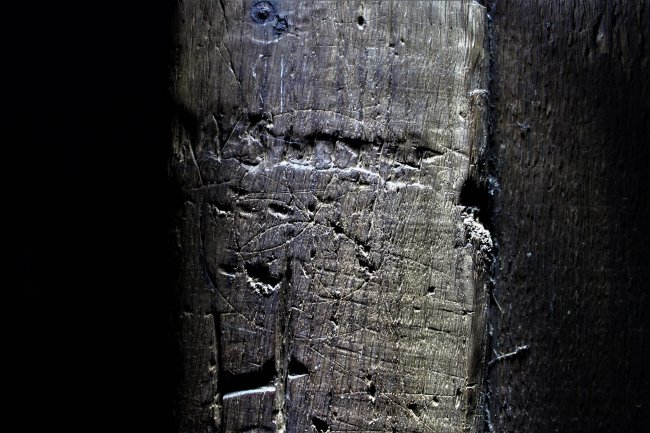
Apotropaic marks are one of the most common forms of surviving graffiti and are found in medieval and later cottages, houses, estate buildings like the bakehouse at Lacock Abbey, Wiltshire, and in many churches. Marks or symbols were made around doors, windows, fireplaces, and other openings in an attempt to prevent evil forces entering the building. They were believed to both protect the inhabitants and users of the building and the building itself. The tradition continued as an ingrained ritual or superstition and marks were probably made in later centuries as a way of promoting good fortune. It is not hard to envisage why there are so many apotropaic marks at the mill which was at constant risk of fire and dependent on good winds and good harvests for its safe running and continued prosperity. There are 23 circles or rosettes on the first and second floors of the mill. Seven circles or rosettes are carved near the first-floor northern window and three circles are located close to the window on the second floor of the south elevation. In all, 16 of the circles and rosettes were close to doors or windows – points seen to be most at risk from entry by evil spirits.
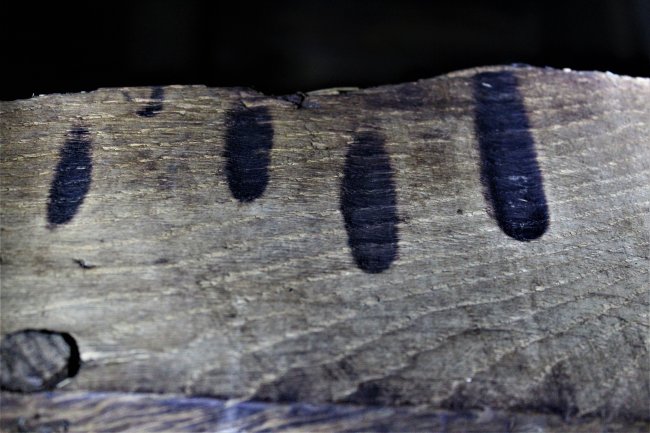
Of the 19 burn marks recorded, a number are found on the western wall plate behind the mill’s gear wheel. James Wright concludes that this is likely to be because it is “a dark area which may have been seen to be vulnerable to spirits”. Burn or scorch marks were made deliberately as a pre-emptive measure to protect against the outbreak of uncontrolled fire or lightning strikes, with the thought that these wouldn’t happen if the building had already been touched by a flame. Three mesh patterns are found on the north elevation for the first floor, and these have been interpreted as most likely reflecting the protective power associated with endless line designs”. The other two forms found – conjoined VV marks and butterfly marks – appear only once in each case. The VV symbol may reflect fidelity to the Virgin Mary – the “Virgo Virginum’ in Latin – but can also be interpreted as the initial ‘W’ or even ‘M’. There is ongoing debate in graffiti studies about potential meanings of this symbol. It is found in the mill on a door jamb alongside three circles or rosettes. The single butterfly mark is inscribed into the main post and is like traditional carpenters’ and stonemasons’ marks.
It is hard to be certain of the original intention of all the apotropaic graffiti for it may have had a very specific meaning or been made in response to a perceived threat which we can no longer ascertain. What is discernible though is that a common medieval belief of warding off evil spirits or catastrophic events through the use of ritual protection marks persisted at Kibworth into the 18th century.
Names and initials
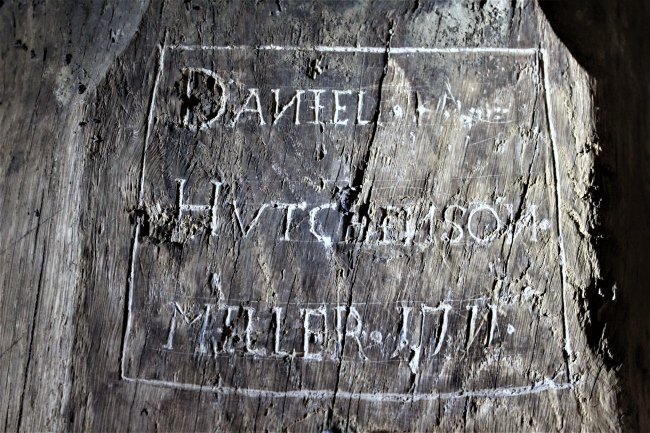
Eight pieces of named graffiti relate directly to millers, with the majority being members of the Smith family who ran the mill throughout the 19th century. All eight names are found on the first floor. The earliest named and dated inscription is that made by miller Daniel Hutchinson, in 1711, on the main post. But all is not quite what it seems and while the date of the inscription can be taken at face value, it may not originally have been part of Kibworth Harcourt Post Mill. We know from documentary records that a mill was built on this site between 1609-35. The main post is the oldest surviving element and was potentially re-used from a different mill or retained from an earlier mill on site when the current mill was re-modelled or re-built in the late 18th century. Dendrochronology dating of the timbers of the buck indicate a felling date of 1773 and the present mill is dated to after this point.
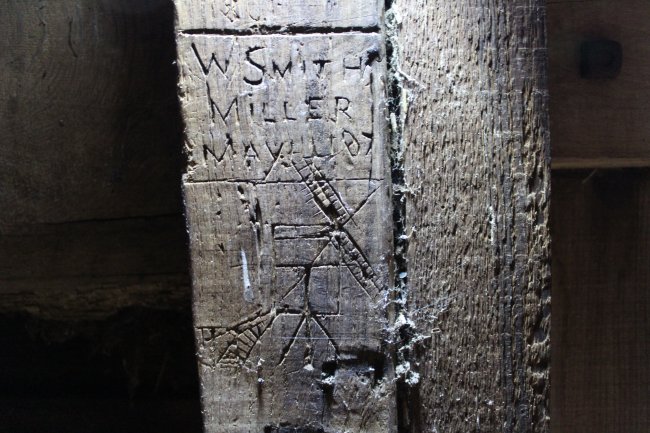
The brick roundhouse is dated to the 1850s when the Smith family held the lease of the mill. The earliest inscription by a Smith is believed to be ‘MILLER W. S. 1837 SEPT 2’ and the last ‘W W SMITH MILLER 1880 KIBWORTH’. One of the most interesting is that of ‘W SMITH MILLER MAY 11, 1876’ which is enlivened by a simple, emblematic graffito of a post mill. This and two other inscriptions from 1870 and 1880 are believed to be the work of William Ward Smith when he was eight, 15, and 19 years old respectively. William Ward Smith was the grandson of Thomas Smith, thought to be the inscriber of ‘T SMITH MILLER OCTO 17 1837’ who is recorded in the 1861 census as miller and baker in Kibworth Harcourt. There is also an assemblage of names and initials on the first floor by people who must have been connected to milling or have been welcome to openly add their mark to the building. These include: ‘GR 1793, ‘WILLIAM FELLOW 1794, ‘EPW 1805’, ‘WT 1811’, ‘1819’, ‘CC 1821’, ‘EG 1838’, ‘CH 1861 and ‘T WELLS 1866’.
Further graffiti of names or initials appears to fall into two camps: that of craftspeople who worked on the repair of the mill and of trespassers who left traces of their visits in the 20th century when the mill was no longer functioning and fell into disrepair. The mill must have been readily accessible to those keen to view the interior, although the ground floor location of most graffiti from this period suggests the upper floors were secured against intruders. Among this graffiti are the following inscriptions: ‘WATTS 31.1930’, ‘FG 17 1932’, ‘HAROLD MASON 1932’, ‘H. FILWELL MEDBOURNE JULY 1934’ and ‘S. NOURIOH MAY 1935’. In 1968 one visitor added their name, date, and home country – ‘SONAROK 1968 CANADA’.
James Wright’s focus on identifying and teasing out the meaning of the graffiti means that we are now able to fully appreciate that the mill’s interiors harbour both an unexpected and exceptional historic record that gives us a tangible connection to past users and visitors to the mill. As he concludes: “By recording the entire assemblage of graffiti, it has been possible to add a new layer of understanding at the site which is intimately connected to the human agency of the people that have been present within the building.” When you visit Kibworth, look at the graffiti and learn more about its varied forms and meaning – but please resist the urge to make your own mark by adding to this fascinating historic record.
Learn more about James Wright's work: Triskele Heritage
Learn more about Kibworth Harcourt Post Mill