

Nichola Tasker, Conservation Architect, 1998 SPAB Scholar and former Chair of Trustees, celebrates Broughton Castle, a fortified and moated manor house. This piece originally appeared in the SPAB members' Magazine in Summer 2026. Become a member to get the next issue.
Imagine that there was a Desert Island Discs for historic buildings. You have to choose your top eight historic buildings of all time. Torture, isn’t it? I’m sure you’d consider some that are architecturally unique, and some where the world turned due to a particular historic event. But the one that you would save from the waves, when all others were lost, surely must be a place which transcends its listing description and Pevsner or Jenkins credentials. It has to be somewhere that has somehow captured your heart. For me, and I’m sure for many others, that place is Broughton Castle.
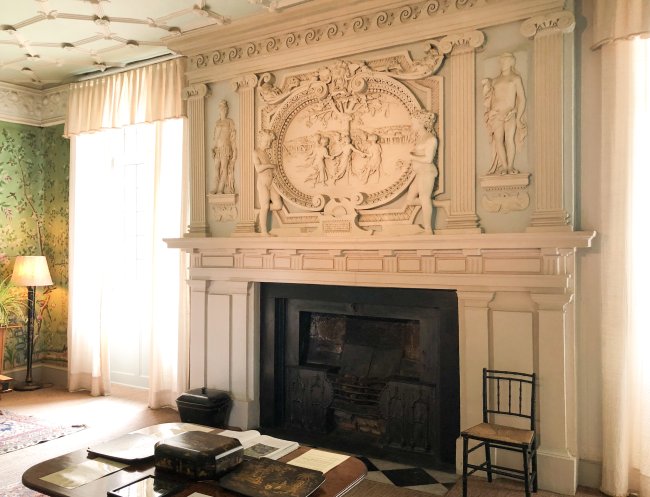
As SPAB Members, I can leave you to do your own research. The images here immediately tell you more than I have space to, about architectural style and materials. I won’t therefore, detail Broughton’s 14th century origins, its 16th century triumphs and its healthy scepticism and magpie selection of only the best post-Renaissance fads and fashions. What I do need to tell you, what you won’t appreciate at first glance is that Broughton is, more than anything else, a home. Let’s think about that word: the warmth, security and stability it conjures up. A home is not a place where everything is easy, and this home has certainly known its fair share of triumphs and disasters. But ultimately, a home is the centre of a family and a community. This, Broughton has been for hundreds of years.
And here, here we start to touch on the relationship between our magnificent, historic buildings and places and the people who live in them. The people who love them, leave them, fight for them or neglect them. In the story of the Fiennes family who have owned Broughton throughout its history, successive generations have done all of the above. But in more recent years, at the back end of the last century and across the millennium, this house has been loved: loved, cherished, and quite simply, nursed back to life.
When Nathaniel Fiennes and his wife Mariette inherited the house in the late 1960s it was in, what we conservation professionals would call, a bit of a state. Resolving to make it their home (there’s that word again!) rather than run it as a museum, they applied what we would now see as a SPAB approach to carefully adapting areas to create modern, cosy (a relative term!) and functional rooms for their young family, while still using and inhabiting the magnificent principal rooms for high days, holidays and Sunday best.
They knew, it seems, that the best way to understand a building is to live in it. As they raised their family, ran the estate, played their role in the community, and supported seemingly every local good cause, so they repaired the house. Bit by bit, decade after decade, the leaks in the acres of roof were fixed, the windows made good, the parapets and label moulds made to shed water again. In the best tradition of the owners of grand houses they not only repaired, but they commissioned new work when they could: new art, new furniture, new stained glass for the medieval chapel.
All of this activity was underpinned by what can only be described as an overwhelming generosity. The house was not only at the heart of local life, but it became a magnet for a generation of the building conservation community. Year after year of Scholars and Fellows were welcomed to climb the scaffold to see the stone repairs or sat and shivered in the Great Hall in daytime sleeping bags, practicing their sketching. Nat and Mariette shared each stage of their repair odyssey with the SPAB and others and as a result, countless conservation professionals went forward from Broughton, having been helped to learn their craft and hone their thinking. And what we learned most, was the difference it makes for a house to be lived in, to be at the heart of family life. Not a monument, but a home.
But I can hear you thinking, what makes this Desert Island material? We know the story. Many country houses didn’t make it through the 20th century, but surely many of the survivors could lay claim to a steadfast family; persevering, doing their best, keeping the roof on? To which I can only say: go. Go visit. Sit in the garden, climb the stairs to the ‘room with no ears’, watch the sunlight reflected from the moat, dancing on the panelling in the Oak Room. Then come and tell me how I should have explained this house. What I should have told you about a place that holds the weight of time in the pleasure of a moment; the warmth of the ironstone reaching cool shadows across on the lawn. And tell me then, that you wouldn’t save it from the waves.
In memory of Nathaniel Fiennes, 21st Baron Saye and Sele, 1920-2024.
Find out more: broughtoncastle.com
Upper image © Bruce M White