

Lydiard Park Mansion
Rachel Broomfield describes the history of this large Wiltshire country house and the eclectic mix of uses it will now accommodate following consent for a partial change of use in March 2026.
In 1943 Lydiard Park was requisitioned by the military and permanently vacated by the owner the 6th Viscount Bolingbroke. The Town Clerk David Murray John then negotiated the sale of Lydiard Park to the Swindon Corporation (now Swindon Borough Council) for £4,500 “for public recreational purposes” as it seems that the house had been empty for some time. The property was not protected in 1943 (being listed as Grade I in 1955), so its survival was extremely fortunate unlike a lot of large country houses which were being demolished.
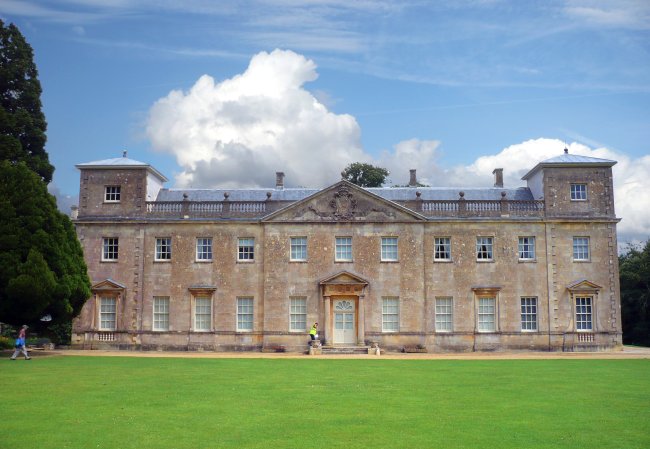
Lydiard Park has a medieval core which is likely to have consisted of a hall with cross wings, extended in the 17th century so the cross wings formed an H-plan. It was extended and re-modelled again between 1745-9, probably by Roger Morris, for John, 2nd Viscount St. John but this was confined to the south and east fronts, forming the central hall, the interconnecting state rooms, the library, dining and drawing rooms, all of which survive. The main stair to rear of the hall was within the earlier structure. The facades were strictly Palladian in design, based on Houghton Hall, Norfolk. The north-west wing and the service wing were later rebuilt in the 1830s, partly on earlier foundations.
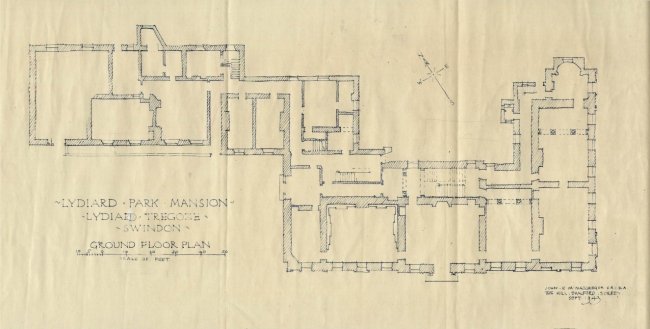
The Swindon Corporation consulted the SPAB’s Technical Adviser in September 1943 who at the time was John E M MacGregor, and we are fortunate to still have a copy of his report and plans. He stated in his report that “the structure is in an exceedingly good state, and I was nowhere able to find signs of settlement or deterioration due to anything but sheer neglect. A relatively small expenditure would have maintained the complete building. The position of the building has luckily saved it from wilful damage by hooligans. Wet is penetrating in many places, and dry rot is rampant in the west wing. There is, however, no doubt that the building presents a far more forlorn appearance than is actually the structural condition.”
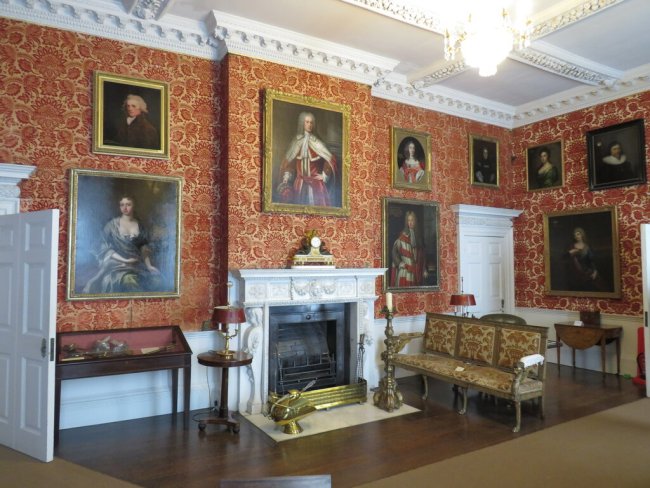
Internally, the decoration and detailing were clearly of very high quality even after several centuries, being described in 1943 as “not only is the detail of the skirting, dado and cornice, exceedingly lavish and good, but it is of most excellent craftsmanship, which remains as perfect today as when executed. The ceilings also are very rich and fine plasterwork. Even the red plush-faced paper of the walls has stood the test of time remarkably well.” This is notable given that the house had been empty an unused for some time and that the detailing referred to was installed almost 200 year earlier!
In their correspondence it is not clear whether the Corporation were asking for the Society’s thoughts on a new use for the building or whether they already had proposals in mind, but John E M MacGregor felt that “seeing that the Council has acquired the Estate for public recreational purposes, this building appears to me to be exceedingly well adapted to form a semi-residential Youth Centre…”
This comment was particularly interesting as fast forward to early 2026 when the Society was consulted on an application to convert part of the building to a Sixth Form for a local secondary school – a remarkably similar use!
Currently the house has a mix of uses. Part of the building has become the publicly accessible Lydiard House Museum which incorporates the impressive 1740s state rooms, entrance hall and corridor on the ground floor and a small part of the first floor. Most of the ground floor of the service wing and the new building on the southwest side are taken up by the Lydiard Park Hotel and Conference Centre, although this section also contains the museum offices and toilets. The upstairs rooms in the main block are currently underused – these were intended as conference facilities but there doesn’t seem to be the demand for them.
The proposals are to change the use of part of the ground floor and the conference facilities into a new Sixth Form Centre for the use of the nearby Lydiard Park Academy. The museum and hotel will remain, and the state rooms will not be affected, but the museum will share a main entrance with the new Sixth Form Centre.
While the physical changes to allow this to happen are relatively minimal and well considered to limit their impact, SPAB commented that the reasoning as to why this was being proposed was unclear and that this information needed to be provided as part of the ‘clear and convincing justification’ that listed building applications must include. Looking at Lydiard Park Academy, it appears to be a spacious site where the existing buildings could be extended, or a new purpose-built facility constructed.
A letter from BBA Architects stated that “the adaptive reuse of Lydiard Park House is required for its viability and survival” but no further information was provided. Whilst we agree that this is important, we are somewhat surprised that alternatives such as extending the hotel accommodation do not appear to have been considered. Would this be less harmful to the building? We would like to have seen an Options Appraisal to look at all possible alternatives and their impacts.
While we do not necessarily object to the proposals, we asked that further consideration be given to what alternative options might be more suitable and how the proposals would impact on the hotel. For example, would guests want to share a building and main entrance with up to 120 students a day? There is also the matter of considerable wear and tear on the historic fabric that will need to be considered alongside signage, possible sound insulation, and the potential loss/relocation of some of the Museum’s facilities.
We understand that the unamended application received consent in March 2026 so we will be interested to see how this eclectic mix of uses works in the longer term.
Links
- Richard Hewlings article for The Georgian Group
- The Hall Lydiard House, Country Life
- Historic Houses website
- Lydiard Park Museum website
- Historic England listing
Images - wikimedia commons CC BY-SA 4.0 and CC BY-SA 2.0 and SPAB archive