

SPAB and its partners are undertaking a detailed programme of monitoring and evaluation aimed at understanding how traditional fabric, modern energy measures and occupant interaction perform in practice. For building professionals, this research provides grounded evidence on fabric performance, moisture behaviour, low-carbon systems and occupant interaction—offering insights that will be directly transferable to the wider historic built environment.
This research is possible because St Andrew’s Chapel, the Old House Project is vacant while a buyer is sought. The project continues to add to our understanding building fabric performance. It provides a rare, evidence-based case study of conservation-led retrofit in a complex historic building.
Although the Government has recently announced its Warm Homes Plan, there is still much to learn about the effects of insulation and heating on our pre-1919 building stock. St Andrew’s with both thin lightweight walls and thick heavyweight solid walls, and incorporating a wide variety of traditional constructional materials, ranging from timber framing to substantial medieval masonry is a valuable place for research to be undertaken.
Historic England have recognised the learning potential of this initiative and have generously awarded SPAB a grant to assist this technical research.

Monitoring started before Christmas and continues with a small team led by Technical and Research Guardian Professor Bill Bordass, Katie Steele of Cheribim and PhD researcher and Wellbeing Surveyor Jason Ratcliffe. They are supported by our Technical & Research Senior Manager Jonny Garlick and Project Architect Mal Fryer.
Over seven years, SPAB repaired and conserved the building in line with our conservation principles while also meeting regulatory and environmental requirements. The retrofit includes internal wood fibre insulation to walls and roofs (with deliberate exceptions where historic or technical constraints apply), secondary glazing, aerogel in window reveals, mechanical ventilation with heat recovery (MVHR), and two air-to-water heat pumps supplying space heating via radiators and domestic hot water.
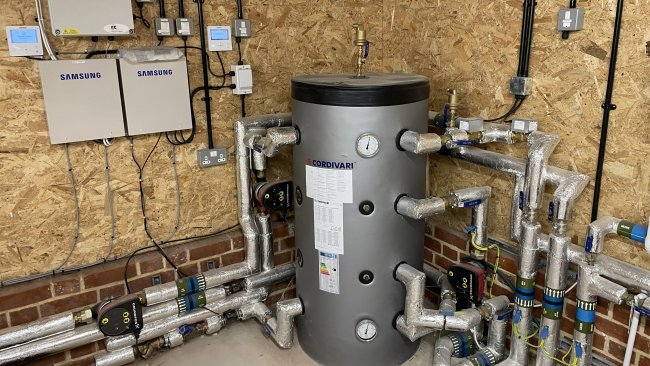
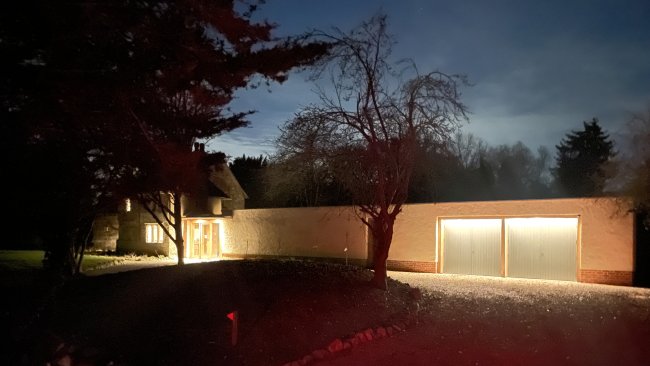
Acoustic and air quality changes are being measured internally and compared against the external environment, after the airtightness of the building had been increased many fold. The building’s new high temperature air source heat pump and MVHR units are being fully optimised for efficiency and compared against energy usage and the actual comfort felt. This new heating technology installed is of the same type the Government is now so keen for everyone to install. At St Andrew’s we want to understand exactly how our sleeping beauty reacts to being awakened and centrally heated for the first time in her 600-year history.
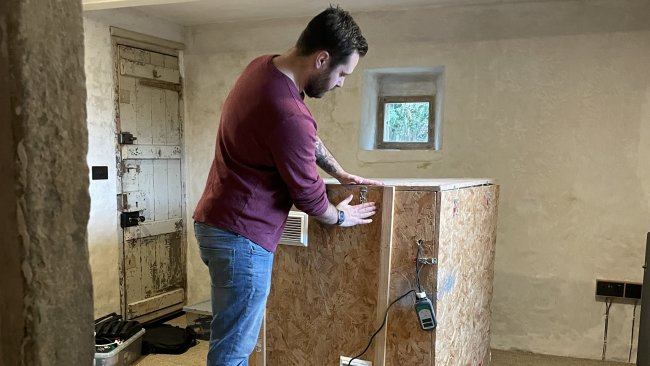
The investigative programme on-site is exploring such things as the U-value and moisture movement within the traditionally constructed walls, particularly where we’ve insulated. Using a temperature-controlled climate chamber method developed by Jason Ratcliffe at the University of Plymouth called the Elemental Cube, researchers will test the U-value at multiple wall locations before and after the heating system is put into operation, with thermographic surveys used to supplement results. This work will help refine field testing methods and clarify how internal insulation performs in traditional masonry.
Indoor air quality is also being monitored, assessing temperature, relative humidity, carbon dioxide, particulates and volatile organic compounds. The proximity to the M20 motorway provides a robust test of how vapour-permeable materials and MVHR perform in a challenging context. Airtightness testing, including pressure tests, thermography, smoke diagnostics and potentially pulse pressure testing, will identify leakage pathways and inform future retrofit detailing.
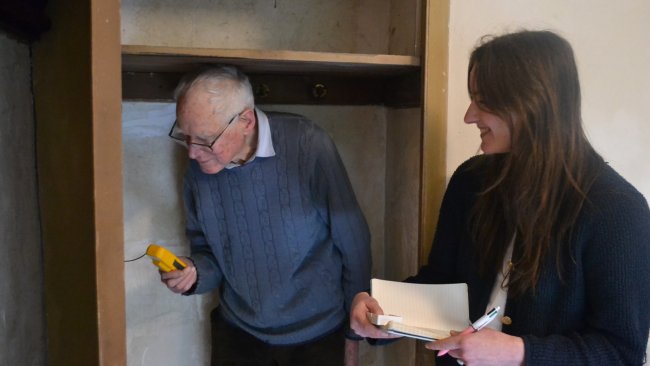
Moisture risk is a central concern in internally insulated historic buildings, and St Andrew’s is now extensively instrumented. Forty-four moisture sensors are deployed across walls, roofs and window reveals using Historic England’s timber dowel methodology and direct-contact measurements in wood fibre insulation. These are tracking the drying-down process and identifying trends over time.
In parallel, the project is testing prototype low-cost wireless moisture sensors designed to transmit data via LoRa networks. The aim is to develop affordable, long-life, multi-channel devices suitable for long-term risk management, potentially enabling ‘fit-and-forget’ monitoring of internally insulated fabric. Development of a clearer, more accessible user interface will allow both occupants and professionals to interpret environmental data, bridging the gap between building physics and practical decision-making.
As part of the project, an on-site researcher will support technical investigations, document findings and translate complex data into usable knowledge for professionals, clients and homeowners. The heating system, involving two air-source heat pumps, buffer storage and multiple pumps and controls, provides an opportunity to examine a real-world system in operation, control strategies and monitoring requirements.
This package also explores people-centred performance. With some rooms highly insulated and others largely unaltered, the house provides a test bed for investigating adaptive comfort, subjective thermal experience and the effectiveness of low-tech interventions such as furnishings or wall hangings, alongside objective environmental measurements.
This phase of research will be completed by March 2026, but it is hoped that a buyer will allow non-intrusive monitoring to continue after occupation to continue this valuable evaluation in conservation-led retrofit.
Research partners
Katie Steele Cheribim
Jason Ratcliffe Wellbeing Surveyor
Bill Bordass
Research supported by
Historic England